

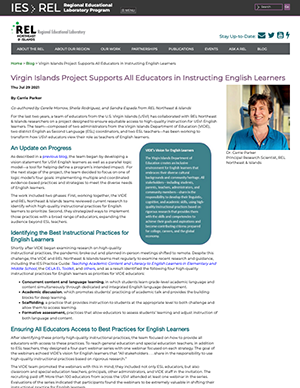
This blog describes a two-year project in collaboration with the Virgin Islands Department of Education to ensure that all educators have access to best practices for English learners. View Resource Citation: Parker, C.E. (2021). Virgin Islands Project Supports All Educators in Instructing English Learners. Regional Educational Laboratory Northeast & Islands. Retrieved from https://ies.ed.gov/ncee/edlabs/regions/northeast/Blog/Post/35 Related Project: … Continue reading Virgin Islands Project Supports All Educators in Instructing English Learners
In this brief, the authors define some of the key terms in bilingual education and then provide an overview of the different state policies for the provision of bilingual education to English learners. View Resource Citation: Rutherford-Quach, S., Torre Gibney, D., Kelly, H., Ballen Riccards, J., Garcia, E., Hsiao, M., Pellerin, E., & Parker, C. … Continue reading Bilingual Education Across the United States
In this brief, the authors share strategies that can help mitigate bilingual teacher shortages and provide considerations for state and district leaders who are interested in addressing these shortages. View Resource Citation: Torre Gibney, D., Kelly, H., Rutherford-Quach, S., Ballen Riccards, J. & Parker, C. (2021). Addressing the bilingual teacher shortage. CCNetwork. Related Project: Mid-Atlantic … Continue reading Addressing the Bilingual Teacher Shortage
In this brief, the authors share strategies that state education agencies may use to provide more flexibility in teacher certification policies and thereby mitigate bilingual teacher shortages, including: 1) providing educators multiple pathways to certification, 2) offering prospective teachers a menu of certification requirements, 3) allowing educators to earn probationary certifications, and 4) creating flexible … Continue reading Leveraging Flexible Teacher Certification Policies to Address the Bilingual Teacher Shortage
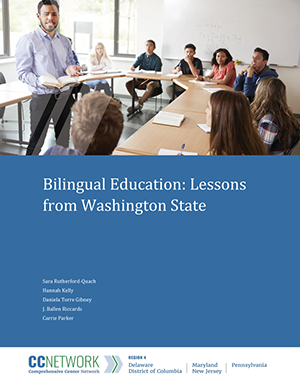
In this brief, the authors describe Washington state’s approach to bilingual education and detail the ways in which state leaders have leveraged policy and funding to expand access to it. They also offer specific policy considerations for strengthening bilingual education and developing bilingual educators in states across the country. View Resource Citation: Rutherford-Quach, S., Kelly, … Continue reading Bilingual Education: Lessons from Washington State
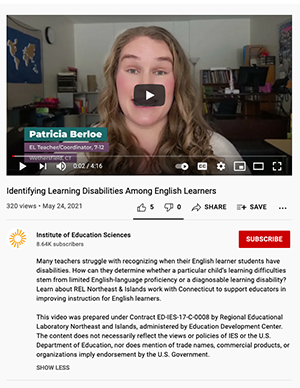
Many teachers struggle with recognizing when their English learner students have disabilities. This video describes REL Northeast & Islands’ work with Connecticut to support educators in improving instruction for English learners. View Resource Citation: Regional Educational Laboratory Northeast & Islands (May 24, 2021). Identifying Learning Disabilities Among English Learners. YouTube. https://www.youtube.com/watch?v=sZVDnSIsCZw&t=2s Related Project: REL Northeast … Continue reading Identifying Learning Disabilities Among English Learners
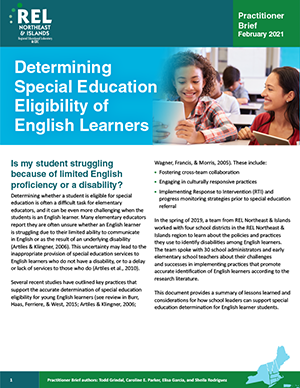
This practioner brief describes four districts are using key practices to identify disabilities among English learners.
A slide deck with a summary of key practices using multi-tiered systems of support with English learners, including tools for understanding language vs. disability, screening and progress monitoring processes and tools, and a description of how to implement the three tiers of multi-tiered systems of support. View Resource Citation: Parker, C.E. & Grindal, T., (2021). … Continue reading Supporting Educators in Determining Special Education Eligibility of English Learner Students
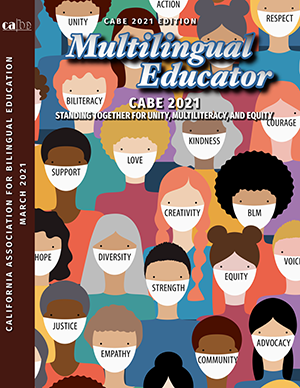
This article describes the 18-month project focused on teacher preparation courses in higher education to promote practice-based learning while earning transferable upper-division undergraduate academic units. View Resource Citation: Oliva-Olson, C. & Arambula-Gonzales, A. (2021). Effective practice-based coursework for dual language educators: A California equity-minded early childhood approach. California Association for Bilingual Educators, 61-65.
This study reports findings from a multisite cluster randomized controlled trial designed to validate and scale up an existing successful professional development program that uses a cognitive strategies approach to text-based analytical writing called Pathway to Academic Success. Multilevel models revealed significant effects on a holistic measure of an on-demand writing assessment (d = .32) … Continue reading The pathway to academic success: Scaling up a text-based analytical writing intervention for Latinos and English learners in secondary school.
This paper describes the preliminary findings from Year 1 of a 2-year efficacy study addressing the following research hypotheses: (1) compared with fourth-grade students using traditional paper-based science notebooks in business-as-usual classrooms, students in the Science Notebook for a Universal Design for Learning Environment (SNUDLE) classrooms will significantly increase their science content knowledge and motivation … Continue reading Efficacy Study of the Science Notebook in a Universal Design for Learning Environment: Preliminary Findings
This report describes data collected in school year 2016–17 to learn about the use of digital learning resources in instructing EL students through a nationally representative survey of districts that enrolled EL students and a teacher survey that included mainstream teachers of EL students and EL specialists, and inlcudes six case studies to provide illustrative … Continue reading Supporting English Learners through Technology: What Districts and Teachers Say about Digital Learning Resources for English Learners Volume I: Final Report
This study examined postschool expectations, transition planning experiences, and supports of a nationally representative sample of English learners with disabilities, based on secondary analysis of the National Longitudinal Transition Study (NLTS) 2012. Results demonstrated that these students’ experiences were similar to other students with disabilities except that, according to parents, the transition component of the … Continue reading Postsecondary Education-Focused Transition Planning Experiences of English Learners With Disabilities
Understanding Language is a resource tool from Stanford University, created as a PD tool for teachers with ELLs. One of the things teachers who complete the courses report is courses have prompted them to incorportate formative assessments with a language lens and involve students in process. View Resource Citation: Rutherford-Quach, S., Kuo, A. C., & … Continue reading Understanding their Language: Online Professional Development for teachers of ELLs
Research on teachers integrating Language proficiency standards with content standards so lessons were rich and still accessible to English learners. View Resource Citation: Patel, D., Wei, X., Laguarda, K., Stites, R., Cheever, H., & Goetz, R. (2018). Evaluation of education connections: Supporting teachers with standards-based instruction for English learners in mainstream classrooms. SRI Education. Related Project: … Continue reading Evaluation of education connections: Supporting teachers with standards-based instruction for English learners in mainstream classrooms